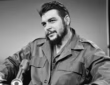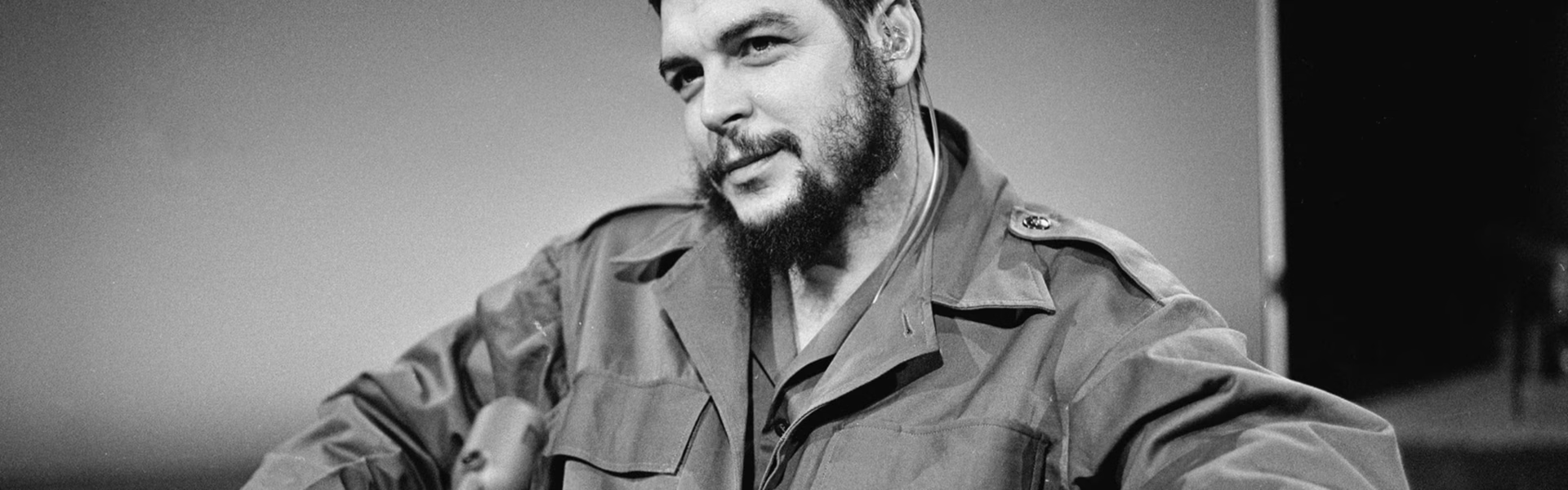

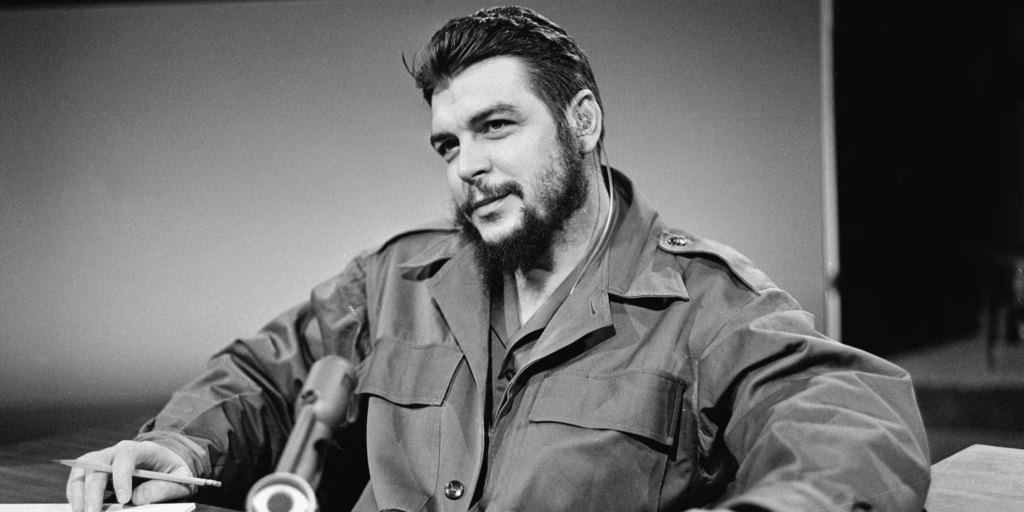
Che Guevara was an Argentine-born Marxist revolutionary, physician, and guerrilla commander who served as one of the central figures of the Cuban Revolution alongside Fidel Castro.
Following his execution in Bolivia in 1967, he became one of the most widely reproduced and contested political images of the 20th century — hailed by many on the political left as a symbol of anti-imperialist struggle and self-sacrifice, and condemned by many others as a ruthless architect of political violence and repression.
Profile
| Full Name | Ernesto Guevara de la Serna |
| Nickname | Che (“El Che”) |
| Date of Birth | June 14, 1928 |
| Date of Death | October 9, 1967 |
| Age at Death | 39 |
| Birthplace | Rosario, Santa Fe Province, Argentina |
| Nationality | Argentine; later granted Cuban citizenship |
| Occupation | Physician, revolutionary, guerrilla commander, government official, author |
| Parents | Ernesto Guevara Lynch (father), Celia de la Serna (mother) |
| Siblings | Eldest of five children |
| Spouse | Hilda Gadea (m. 1955–1959, divorced); Aleida March (m. 1959–1967, his death) |
| Children | Five, including Hildita (with Gadea) and Aleida, Camilo, Celia, and Ernesto (with March) |
| Net Worth | Not applicable; Guevara held no significant personal wealth and is not associated with a documented net worth. |
Early Life
Ernesto Guevara de la Serna was born on June 14, 1928, in Rosario, Argentina, the eldest of five children in a politically left-leaning, upper-middle-class family.
His father, Ernesto Guevara Lynch, was a civil engineer of Irish descent, and his mother, Celia de la Serna, came from a family of Irish and Spanish heritage.
At age two, Guevara suffered a severe asthma attack, and the condition affected him for the rest of his life, though he remained an avid athlete and reader as a child and adolescent.
Education
Guevara studied medicine at the University of Buenos Aires, earning his medical degree in 1953.
During his university years, he undertook an extended motorcycle journey across South America in 1951–1952 with his friend Alberto Granado, an experience later documented in his memoir The Motorcycle Diaries, during which his direct exposure to poverty and social inequality across the continent significantly shaped his political outlook.
Career
After completing his medical studies, Guevara left Argentina in 1953 and traveled to Guatemala, where he witnessed the CIA-backed overthrow of the democratically elected government of Jacobo Árbenz in 1954, an event that deepened his commitment to revolutionary politics. It was in Guatemala that he adopted the nickname “Che,” a colloquial Argentine term roughly meaning “pal” or “mate.”
He subsequently fled to Mexico, where he met Fidel and Raúl Castro and joined their movement to overthrow Cuban dictator Fulgencio Batista. Guevara took part in the 1956 landing of the yacht Granma in Cuba and the ensuing guerrilla campaign in the Sierra Maestra mountains, rising to the rank of comandante and playing a key role in military victories that led to Batista’s fall on January 1, 1959.
Following the revolution’s success, Guevara held several senior positions in the new Cuban government, including President of the National Bank of Cuba and Minister of Industries, and represented Cuba in international forums while advocating for radical land reform and industrialization.
In 1960, he published Guerrilla Warfare, an influential manual outlining his theories on revolutionary insurgency, which went on to influence armed movements across Latin America, Africa, and Asia.
In 1965, Guevara resigned his official positions and Cuban citizenship, first to lead a failed guerrilla campaign in the Congo, and afterward to organize an insurgency in Bolivia, aiming to spark continent-wide revolution.
His Bolivian campaign was betrayed and unraveled; on October 8, 1967, he was captured, wounded, by the Bolivian army in the Quebrada del Yuro.
He was executed the following day, October 9, 1967, on the orders of the Bolivian government, reportedly with U.S. intelligence involvement. His remains were buried in an unmarked grave in Bolivia and remained undiscovered until 1997, when they were exhumed and reinterred in Santa Clara, Cuba.
Awards & Nominations
Formal awards and nominations, in the conventional sense, are not applicable to Che Guevara’s career as a revolutionary and government official.
Social Media
Not applicable; Guevara died in 1967, decades before the advent of social media.
Personal Life
Guevara married Peruvian economist Hilda Gadea in 1955; the couple had one daughter, Hildita, before divorcing in 1959. That same year, he married Aleida March, a fellow Cuban revolutionary, with whom he had four children: Aleida, Camilo, Celia, and Ernesto. Guevara’s legacy remains one of the most politically contested in modern history.
Supporters and many left-wing movements regard him as an icon of anti-imperialist and anti-capitalist resistance and self-sacrifice, commemorating him through the widely reproduced Alberto Korda photograph “Guerrillero Heroico.”
Critics, including many historians and governments, point to his direct role in the summary executions of alleged dissidents and Batista-era officials at Havana’s La Cabaña fortress following the revolution, and to his broader advocacy of revolutionary violence, arguing this record complicates or undermines his status as a heroic figure. Both perspectives continue to shape public discussion of his life.
Net Worth
Not applicable. Che Guevara did not accumulate significant personal wealth, and no documented net worth figure exists for him.
Major Works & Legacy
- The Motorcycle Diaries (memoir of his 1951–1952 South American journey, published posthumously)
- Guerrilla Warfare (1960, military/political treatise)
- Key military and political role in the Cuban Revolution (1956–1959)
- President, National Bank of Cuba (1959–1961)
- Minister of Industries, Cuba (1961–1965)
- Leader of failed revolutionary campaigns in the Congo (1965) and Bolivia (1966–1967)
Conclusion
Few 20th-century political figures generate as much enduring disagreement as Che Guevara.
Whether viewed as a martyred revolutionary idealist or as a symbol of authoritarian political violence, his life and image continue to occupy a central place in debates over revolution, socialism, and political violence more than half a century after his death.