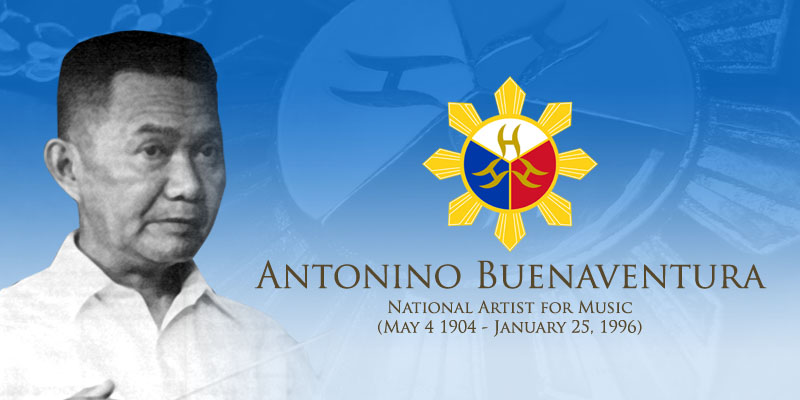

Antonino Ramirez Buenaventura is one of the most significant figures in Philippine musical history.
A composer, conductor, teacher, and military band director, Buenaventura’s seven-decade career advanced the frontiers of Philippine music in ways that few could match.
Named a National Artist for Music in 1988, he inscribed multiple “firsts” in the country’s musical record books and helped elevate Filipino classical composition to international recognition.
Profile
| Full Name | Antonino Ramirez Buenaventura |
| Born | May 4, 1904 |
| Birthplace | Baliuag, Bulacan, Philippines |
| Died | January 25, 1996 (aged 91) |
| Nationality | Filipino |
| Occupation | Composer, Conductor, Educator, Military Officer |
| Spouse | Rizaliana Exconde |
| Awards | National Artist of the Philippines (Music, 1988) |
Early Life
Antonino Buenaventura was born on May 4, 1904, in Baliuag, Bulacan a province historically known as a cradle of Filipino arts and culture. He was born into a deeply musical family; his father, Lucino Buenaventura, was a musician at the Spanish Artillery Band in Intramuros, Manila. His brothers Federico and Feliciano were also musicians. Growing up in such an environment, music was not simply a hobby for young Antonino it was the very air he breathed. He absorbed classical and folk influences from his earliest years, developing a keen ear and an intuitive understanding of musical structure.
Education
Buenaventura studied at the Philippine Conservatory of Music (later the University of the Philippines Conservatory of Music), where he earned a Teacher’s Diploma in Music, majoring in Science and Composition, in 1929. His mentors included the legendary Nicanor Abelardo. He also pursued postgraduate studies in Composition under German Professor Jeno Von Tackacs for three years. This rigorous training in both Filipino folk traditions and European classical forms gave Buenaventura the broad musical vocabulary he would use throughout his career.
Career
Buenaventura joined the UP Conservatory as an assistant instructor immediately after graduation in 1930. When his mentor Nicanor Abelardo died in 1934, Conservatory Dean Francisco Santiago designated Buenaventura to take over Abelardo’s classes. In 1935, he collaborated with Francisca Reyes-Aquino to conduct groundbreaking research on Filipino folk songs and dances, work that helped popularize Philippine folk music nationally. He served as music instructor and band conductor at the Philippine Military Academy and conducted the Philippine Constabulary Band. In 1961, he was appointed music director of the University of Santo Tomas Conservatory of Music, where he reorganized the UST Symphony Orchestra. He founded music schools and composed prolifically works that incorporated Philippine folk music into classical Western forms. His composition “AFP on the March” (1957) became the marching music used during military ceremonies, inspections, and graduations. He was the first Filipino to compose a four-movement symphony for orchestra (Symphony in C, 1961), a four-movement symphony for symphonic band (Second Symphony in E-flat, 1977), and several other landmark concertos. His orchestral compositions were performed in Russia, Greece, and Israel, bringing Filipino classical music to international audiences.
Awards and Nominations
Band Conductor of the Year (1951, Music Lovers Society); Republic Cultural Heritage Award for Music (1966, for Symphony in C); Araw ng Maynila Cultural Award (1971); Award of Merit for Outstanding Contribution to Philippine Music (1976, Philippine Army); Director Emeritus of the University of the East (1981); National Artist of the Philippines for Music (1988); Doctor of Humanities honoris causa (1991, University of the Philippines); Diwa ng Lahi Award (1995).
Personal Life
Antonino Buenaventura was married to Rizaliana Exconde. He was known as a meticulous, disciplined musician who brought the same rigour to his teaching and conducting as he did to his composing. He was deeply committed to the development of a distinctly Filipino musical identity, blending indigenous melodies and rhythms with the formal structures of Western classical music. He died on January 25, 1996, aged 91, after a career that spanned seven extraordinary decades.
Notable Compositions
Pandanggo sa Ilaw (most popular folk-inspired composition); AFP on the March (1957); Symphony in C (1961); Second Symphony in E-flat (1977); Parangal Concerto for Piano and Symphonic Band (1981); Concertos for bassoon, trumpet, and French horn; Anino ng Kahapon (opera, 1951) the first locally composed and staged opera in the Philippines.
FAQs
Why is Antonino Buenaventura a National Artist?
He was proclaimed National Artist for Music in 1988 for his seven-decade contribution to Philippine music, including pioneering symphonic compositions and folk music research.
What is Buenaventura’s most famous composition?
Pandanggo sa Ilaw is his most widely known composition, beloved for blending Filipino folk dance traditions with classical orchestration.
Conclusion
Antonino Buenaventura’s life was a symphony of achievement one built on discipline, cultural pride, and an unwavering belief in the richness of Filipino music. From his humble beginnings in a musical family in Baliuag, Bulacan, to his recognition as a National Artist, he carved a path that generations of Filipino composers continue to walk. His legacy lives in every performance of his compositions, in the orchestras he trained, and in the enduring identity he helped give to Philippine classical music.