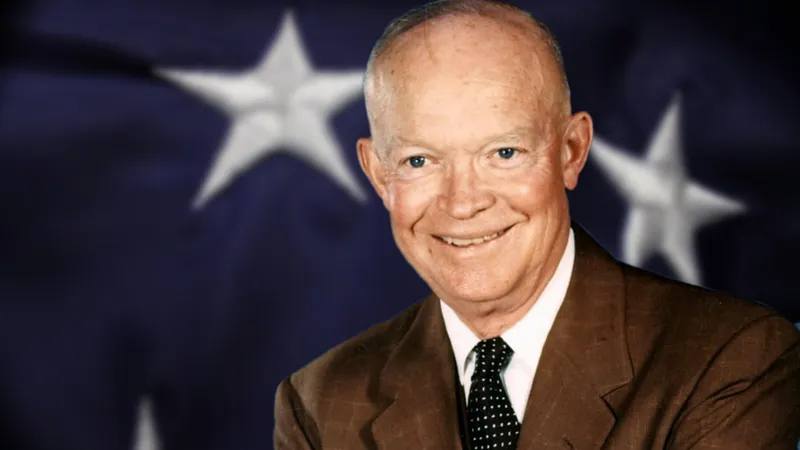
Dwight D. Eisenhower rose from a modest Kansas upbringing to become Supreme Allied Commander in Europe during World War II and, later, the 34th President of the United States.
He is remembered for planning the D-Day invasion, guiding the country through the early Cold War, and reshaping American infrastructure with the Interstate Highway System.
Profile
| Full Name | Dwight David Eisenhower |
| Date of Birth | October 14, 1890 |
| Date of Death | March 28, 1969 |
| Age at Death | 78 |
| Birthplace | Denison, Texas, U.S. |
| Nationality | American |
| Occupation | U.S. Army General; 34th President of the United States (1953–1961) |
| Parents | David Jacob Eisenhower (father), Ida Elizabeth Stover Eisenhower (mother) |
| Siblings | Six brothers (Dwight was the third of seven sons) |
| Spouse | Mamie Geneva Doud Eisenhower (m. 1916) |
| Children | Doud Dwight Eisenhower (1917–1921); John Sheldon Doud Eisenhower |
| Net Worth | No verified net worth figure is currently available. |
Early Life
Dwight David Eisenhower was born on October 14, 1890, in Denison, Texas, to David Jacob Eisenhower and Ida Elizabeth Stover Eisenhower. The family lived in a small house near the railroad tracks while his father worked cleaning train engines.
The following year, the family moved to Abilene, Kansas, where Eisenhower was raised as the third of seven sons in a family of modest means.
Education
Eisenhower attended the United States Military Academy at West Point, graduating before the United States entered World War I. Despite hoping for a combat command in France, he was instead assigned to administrative posts.
Career
After West Point, Eisenhower served in a series of administrative assignments under senior military leaders including John J. Pershing, Fox Conner, and Douglas MacArthur in the years between the world wars.
His standing rose dramatically during World War II, culminating in his appointment as Supreme Allied Commander of Allied forces in Western Europe, where he planned and commanded the D-Day invasion of German-occupied France on June 6, 1944.
He was appointed U.S. Army Chief of Staff in 1945 and became the first Supreme Allied Commander of NATO in 1951. In 1952, running under the slogan “I Like Ike” with Senator Richard Nixon as his running mate, Eisenhower defeated Adlai Stevenson to become the 34th President of the United States, and was re-elected in a landslide in 1956 despite having suffered a heart attack in 1955.
As president, he negotiated an armistice ending the Korean War in 1953, promoted the “Atoms for Peace” initiative at the United Nations to ease Cold War tensions, authorized covert anti-communist CIA operations, strengthened Social Security, and created the Interstate Highway System.
He also used federal troops to enforce school desegregation following Brown v. Board of Education, while facing criticism for not more fully enforcing civil rights nationally. He served two terms, from January 20, 1953, to January 20, 1961, before retiring to a farm in Gettysburg, Pennsylvania.
Political Achievements & Offices Held
- Supreme Allied Commander, Allied Expeditionary Force, Western Europe (World War II)
- Planned and commanded the D-Day invasion of Normandy (June 6, 1944)
- U.S. Army Chief of Staff (1945)
- First Supreme Allied Commander, NATO (1951)
- 34th President of the United States (1953–1961)
- Negotiated the armistice ending the Korean War (1953)
- Launched the “Atoms for Peace” initiative at the United Nations
- Created the U.S. Interstate Highway System
- Deployed federal troops to enforce school desegregation in Little Rock, Arkansas (1957)
Social Media
Not applicable; Eisenhower’s life and career predate social media.
Personal Life
Eisenhower married Mamie Geneva Doud in 1916. The couple had two sons: Doud Dwight Eisenhower, who died in infancy in 1921, and John Sheldon Doud Eisenhower.
After leaving office, Eisenhower and Mamie retired to a farmhouse in Gettysburg, Pennsylvania, where he kept an office at Gettysburg College and wrote his memoirs.
Although he had resigned his military commission upon becoming president, his successor, John F. Kennedy, reactivated it. Eisenhower died on March 28, 1969, at Walter Reed Army Hospital in Washington, D.C., following a long period of heart-related illness.
He received both a state funeral in the nation’s capital and a military funeral in his hometown of Abilene, Kansas.
Net Worth
No verified net worth figure is currently available for Dwight D. Eisenhower.
Conclusion
From a childhood of modest means in Kansas to command of the largest Allied invasion force in history and two terms as U.S. president, Dwight D. Eisenhower’s career left a lasting imprint on both the military and civilian infrastructure of the United States, most visibly through the interstate highway system that still bears his name.